
Challenges
Each case is based on real challenges and needs identified through user research and expert interviews.
Challenge 1
Invisible Disabilities
Imagine having to navigate an airport filled with noise, people everywhere and constant distractions and feeling overwhelmed about where to go. You planned your journey down to every detail, but one unexpected gate change, extra security check or break in your routine can make the whole structure fall apart.
Despite increased awareness in recent years, millions of people with ADHD, people on the autism spectrum, people experiencing anxiety, cognitive challenges or other invisible disabilities still face overwhelming barriers when navigating public transportation and other public spaces. From sensory overload in crowded environments to unclear signage and unpredictable changes – it is exhausting, and can be the difference between participating or staying at home.
When all your energy goes into simply figuring out how to get from A to B, there is little left for social interaction once you arrive. Many people with invisible disabilities may need more time, support and patience when moving through public environments.
This calls for new approaches that go beyond diagnostic labels and focus on individual needs. There is a strong need for solutions that help people with invisible disabilities travel with greater ease, confidence and autonomy – whether they are on their way to the airport, on a bus, train, or visiting a shopping centre.
So how might we develop intuitive, mobile and inclusive tools that support planning, navigation and access to relevant information when needed – in a way that reduces cognitive load rather than adding to it?

Design Constraints:
- The solution must be usable in crowded and noisy environments without drawing attention.
- Mental energy is a limited resource – the solution must be intuitive and user-friendly, requiring as little cognitive effort as possible.
- The solution should be portable and flexible enough to support a range of different invisible disability needs.
Case 1
Team 5: CALMPATH
Wiktoria Kawa, Chrysiida Drakopoulou, Mariam Said, Jakub Piotrowski, Pavel Savinov
Calm Airport Navigation for Neurodivergent Travelers. Airports can be overwhelming with bright lights, loud announcements, and large crowds, often leading to sensory overload and anxiety for neurodivergent travelers. CALMPATH is a personalized navigation assistant that guides users through the airport via “calmer routes” designed to avoid noise and crowds. The app offers step-by-step guidance with a low-stimulus interface and includes features such as mini-games for breaks, a directory of quiet spaces, and a discreet digital staff card. By fostering independence and confidence, CALMPATH ensures a more inclusive passenger journey for everyone.


Case 1
Team 6: TROLLEYBUDDY
Ananya Patankar, Danna Valentina P. Sanchez, Ane Caroline Aaen, Anne F. Hutcheson, Pravdomil Toman
Your Personal Guide Through Airport Chaos.
Airports are often characterized by massive information overload, which can be overwhelming for neurodivergent travelers and create uncertainty about reaching the gate on time. In fact, 60% of passengers overestimate how long it takes to get there, fueling unnecessary stress. TrolleyBuddy solves this by integrating an intelligent screen directly into the airport luggage trolley. The interface provides a simple overview of the route, boarding time, and gate changes, eliminating the need to constantly check phones or confusing departure boards. It is a solution that makes the journey easier for everyone – from the tired traveler to those needing extra support to stay calm.
Case 1
Team 7: GUIDIN
Asmaa A. O. Aden, Satya Libert, Ayushman Sihag, Jin Choi
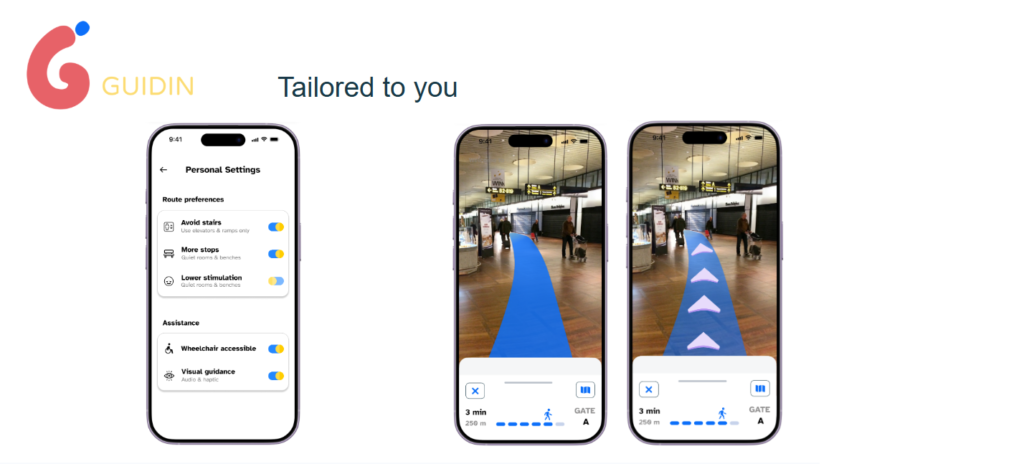
Navigation Tailored to Your Needs. For travelers with invisible disabilities such as ADHD or chronic pain, navigating large airports can be an overwhelming challenge. GUIDIN is a personalized navigation app designed to bring comfort, confidence, and independence to every traveler. The app stands out by offering route planning tailored to individual needs, such as avoiding stairs, prioritizing lower stimulation, or including extra rest stops in quiet rooms. Featuring advanced Augmented Reality (AR) guidance directly on the screen and time-sensitive boarding notifications, GUIDIN ensures that users feel supported and secure all the way to their gate.

Case 1
Team 8: PANDA
Lidiia Moisieieva, Mark van Damme, Ruimin Zhang, Pedro Costa
Your Invisible Navigation Assistant. For many individuals with invisible disabilities, navigating public spaces without the right support can be a significant barrier. Panda is a navigation assistant designed to make the journey secure and manageable through personalized settings. The app allows users to choose exactly the type of assistance they need – whether it’s visual cues with large icons, voice guidance, or haptic feedback through vibrations. By combining a simple interface with real-time navigation and progress tracking, Panda helps users of all ages maintain their independence and reach their destinations safely.
Case 1
Team 9: Be on Time
Selma Ranløv, Lotte M. Klixbüll, Sidsel Rasmussen, Christian Munch Skylv, Mohammed Al Saadi
Peace to zone out without being late. For many individuals with ADHD or autism, public transport during rush hour can be a major source of cognitive fatigue, often causing them to “zone out” and miss their stop. B on Time addresses this by shifting focus from complex screens to intuitive, haptic feedback. The solution consists of a background app that aggregates data from familiar travel interfaces and a discreet wearable device that provides a gentle vibration one minute before arrival. Developed by a team with lived experience in autism, ADHD, dyslexia, and blindness, the solution is built with deep accessibility insights; it assists dyslexic users by replacing street names with simple directional cues and supports blind users via audio signals in their headphones. B on Time makes daily travel 10% less stressful by giving users the peace of mind to disappear into their own world, knowing the technology will call them back in time.


Case 1
Team 10: DSBetter
Nana Piathip Saengduan, Lisbeth Andersen, Anmol Agarwal, Tor Ohlsson, Asger Falck
Accessible Station Service Terminal. Many passengers with invisible disabilities can feel lost or “trapped” in busy station environments, where information from loudspeakers and displays is often difficult to navigate. DSBetter addresses this by introducing a physical, digital service terminal specifically designed to foster independence and predictability. The terminal offers a bidirectional communication system with quick help options, route information, and dedicated accessibility features such as audio support and tactile buttons. By providing a reliable touchpoint on the platform, DSBetter ensures that all travelers can access immediate assistance and precise information, improving the station experience for everyone.
Case 1
Team 11: CUE
Philippa Helfrich, Tailiê Gomide Tonetto, Naia Urraca, Harro Krog, Charalampos Stathopoulos
Your Personal Guide to a Predictable Journey.
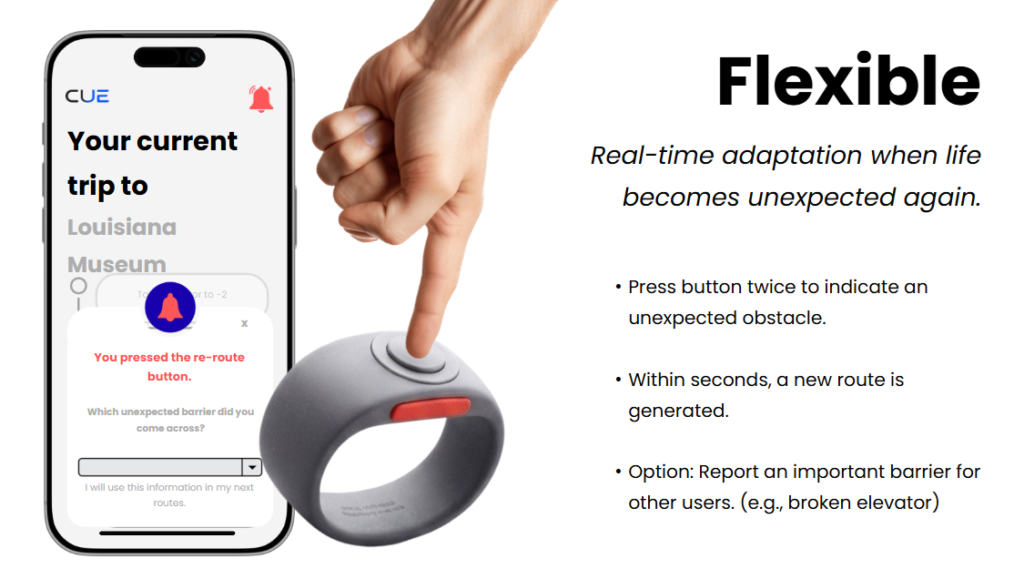
CUE is designed to assist travelers with invisible disabilities by creating a deep understanding of their individual needs through an AI-based profile. The system thinks ahead by providing real-time information on destination accessibility and crowdedness, allowing users to avoid, for example, an unusually busy museum. The most unique aspect of CUE is the physical device that guides the user with dynamic route directions directly to the most suitable entrances and exits, eliminating the need to look at a phone. With features like a dedicated “panic button” and the ability to instantly generate a new route when facing unexpected obstacles, CUE returns control and security to the user in public spaces. See the prototype here.

Case 1
Team 12: easYwaY
Victoria Taylor, Inyoung Chae, Lilly Wong, Filip Ustrobinski, Junyu Xu
Find Your Calm Path Forward. While existing services like Google Maps and Rejseplanen often focus on wheelchair access or the fastest route, there is a market gap for the 17% of the population with invisible disabilities. easYwaY is a navigation app designed specifically to provide guidance and support for this demographic by offering alternative route options. Users can choose a “Quiet Lane” to avoid crowds, a “Scenic Pathway” for a calm trip with stunning views, or a “Smooth Journey” for ultimate accessibility. Featuring text size control, an emergency button, and a customized menu, the app reduces stress and increases autonomy in everyday mobility.
Case 1
Team 13: Cobility
Seoyoon Huh, Kaveh Rashvand, Yasmine Kennou, Pedro Diniz, An Yilin
Navigating the world on your own terms. For the 15-20% of the global population who are neurodivergent, everyday navigation can lead to cognitive fatigue and social isolation. Cobility is built on the vision that the world should be navigable for everyone. The solution is a system that allows neurodivergent individuals to plan and navigate the world on their own terms. The app offers two unique modes: “Plan Mode,” for preparing a route in detail, and “Go Mode,” providing real-time, step-by-step guidance using Augmented Reality (AR). By providing the user with control and predictability, Cobility ensures that no one has to stay home to feel safe.


Case 1
Team 14: Travel Calm
Lara Freire, Lekha D., Beatriz Carneiro, Fabian Wigforss, Emil Zawistowski
Travel on your terms. Large airports can be a source of intense sensory overload, lack of assistance, and significant challenges when facing unexpected changes. Travel Calm is a digital travel companion that enables travelers to “travel in peace” by offering tools for both preparation and real-time navigation. The app allows users to walk through the airport virtually before arrival, plan exact timing for each step, and receive personalized routes based on a unique “Sensory Guide”. By utilizing modern 3D modeling and real-time updates, Travel Calm helps users navigate away from noise and crowds, ensuring the journey happens on the user’s own terms.
Case 1
Team 15: TEDDY
Nafsika Theou, Lin Nora Tollefsen, Maria Foschi, Julien Chalhoub, Akash Neil Das
Your Intelligent Companion for a Calm Journey.
For many travelers with invisible disabilities, the journey to the airport is often overshadowed by anxiety about sensory overload and the chaos of juggling multiple apps. Teddy is an innovative travel companion that consolidates real-time data from public transport, flights, and calendars into a single, simple dashboard. Users can customize their own digital companion and access a “Community Sensory Map,” where others share feedback on noise and overstimulation levels. Teddy acts as an intelligent support system that steps in during events like train delays with supportive messages, breathing exercises, or mini-games to prevent panic. By transforming complex journeys into clear, guided steps, Teddy ensures that everyone can reach their gate with confidence and peace of mind.

Case 1
Team 16: Chestnut
Èlia Lloansí Gelabert, Dania Andreakou, Veronika Akmalova, Katharina Kessler, Leonhard Pauli
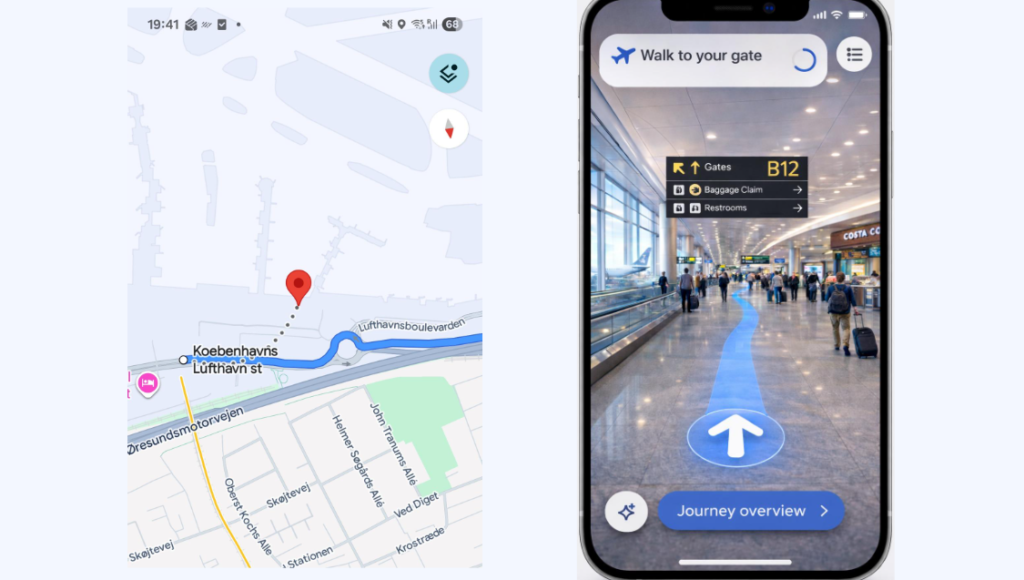
Your safe space on the move. Airports can be extremely challenging for individuals with invisible disabilities due to sensory overload and unexpected changes, such as a sudden gate change. Chestnut acts as a personal travel companion that considers the user’s specific needs, such as preferences for routes that are less noisy or crowded. Using an intuitive interface and Augmented Reality (AR) navigation, the app calmly guides the user through the airport. If changes occur during the journey, Chestnut steps in immediately to lead the user safely to their destination, eliminating uncertainty and turning the trip into a calm experience.

Design Constraints:
- The solution must be portable and flexible enough to receive and organise information from multiple sectors.
- Time and energy are extremely limited – the solution must be intuitive and user-friendly, requiring no unnecessary effort.
- The solution must consider that relatives often operate in a space with high emotional load and a constant need for both structure and support.
Challenge 2
Family and Caregivers
Parents and relatives of people with disabilities often face life situations so demanding that they lead to exhaustion, mental stress, guilt and feelings of inadequacy. Experience from family-focused support initiatives shows that parents of children with disabilities are, on average, in contact with 33 different professionals per year, and they are often left with the full responsibility of managing this without a clear overview of who does what, when and where.
This requires intense coordination from parents: keeping track of meetings with professionals, therapy plans, medical appointments, messages from the school or institution, health recommendations and social activities – all while trying to create a stable and safe everyday life for the whole family. Parents often describe it as being “the project manager of a life – without ever being given a manual.”
“You don’t have time to go looking for help – you need the help to find you.”
Many relatives therefore express the need for a kind of personal project coordinator – a tool that gathers information, synchronises appointments and creates structure in a complex daily life. A tool that ties things together rather than adding new tasks.
A strong network of other parents and caregivers can be the difference between feeling lost and feeling supported. Many are looking for contact with families who understand their reality – who can share experiences, tips and strategies, and offer emotional support in “a role no one teaches you to navigate.” They often sit with questions that others have already solved, yet don’t know where to ask. They need a solution that connects relatives to each other and to relevant resources.
So how might we develop a solution that helps relatives coordinate and structure information across sectors (education, health, municipality), while also being intuitive, flexible and adapted to each family’s needs – and at the same time supports access to networks, knowledge sharing and emotional support?
Case 2
Team 2: Insight Link - A Caregiver Community
Chen Yu, Shivani Kumar, Razvan Gheorghe, Yuhan Xia, Oswaldo Hernandez
Strengthening Support Networks for Caregivers.
Many caregivers struggle with social isolation and an overwhelming lack of accessible knowledge. Insight Link addresses this by consolidating decentralized resources into a single accessible platform that functions as a digital support network. The solution offers real-time guidance and tools to enhance caregiver productivity while bridging the information gap that often leaves caregivers alone with emotional and financial burdens. By centralizing information and fostering a strong community, Insight Link ensures that no caregiver has to manage their responsibilities in isolation.


Case 2
Team 4: UniCaris
Hanne Hansen, Steve Zimmerman, Louis Leblanc, Yvonne Lamisi Bukari, Andrea Lukacs
An All-in-One Platform for the Entire Care Journey.
For many caregivers, daily life is characterized by “coordination chaos,” where critical information is scattered across countless apps, calendars, and messages. UniCaris was built by caregivers for caregivers to solve this problem through a single, unified platform. The solution integrates everything from medication tracking and daily logs to smart coordination between multiple caregivers and access to vital health records. By centralizing practical tasks, the risk of burnout is reduced, finally giving caregivers the mental space and time to rest. As their motto goes: “Use the app. Take a nap”.
Challenge 3
Communication
Communication is our entry ticket to the social world – whether it’s hanging out with friends, saying the right thing on a date, taking part in education or being able to perform at work.
Communication difficulties cover a wide range of experiences: from people living with dyslexia, to people who communicate using sign language, to individuals with speech challenges or those who use AAC (Augmentative and Alternative Communication) devices to convert text into speech.
For many, communication challenges feel like having something important to say but not being able to get the words out. You know exactly what you want to express, but the person you are talking to doesn’t understand you. The pace of the conversation and the struggle to be understood make the interaction feel awkward and every attempt to correct the misunderstanding feels like digging deeper into confusion.
These experiences are part of everyday life for millions of people with communication difficulties – both in face-to-face interactions and in written digital communication.
So how might we develop a solution that supports communication for people with communication difficulties?
The solution must consider pace and flow, and help convey messages and intentions – both from and to the user – in real time.
And how might we develop a solution that makes it possible to express oneself digitally – clearly, safely and with the right intention? A great solution shouldn’t just translate words – it should translate intentions, emotions and needs, and create a sense of being understood and being able to express oneself.

Design Constraints:
- The solution must be usable in noisy environments.
- It must allow users to hold a private or intimate conversation in a public space – without drawing attention.
- The solution must be portable and easy to use in daily life.
Case 3
Team 1: OSMOSIS AI
Jens Christian Sørensen, Liv Bechet, Almina Kocabas, Gifhar Rahman
A Real-Time Assistant for Natural Communication.
Osmosis AI tackles one of the most significant barriers in daily life for individuals with communication disabilities: the rapid pace of natural conversation. Because traditional tools like typing or eye-tracking are often too slow to keep up with quick speech, Osmosis AI bridges the gap using intelligent AI. The solution acts as a real-time communication assistant that understands the context of a conversation and generates responses quickly. This enables users to express their exact intent and participate actively in social interactions as they happen—making conversations more inclusive and natural for everyone involved.

Case 3
Team 3: A KEYBOARD THAT KNOWS YOU
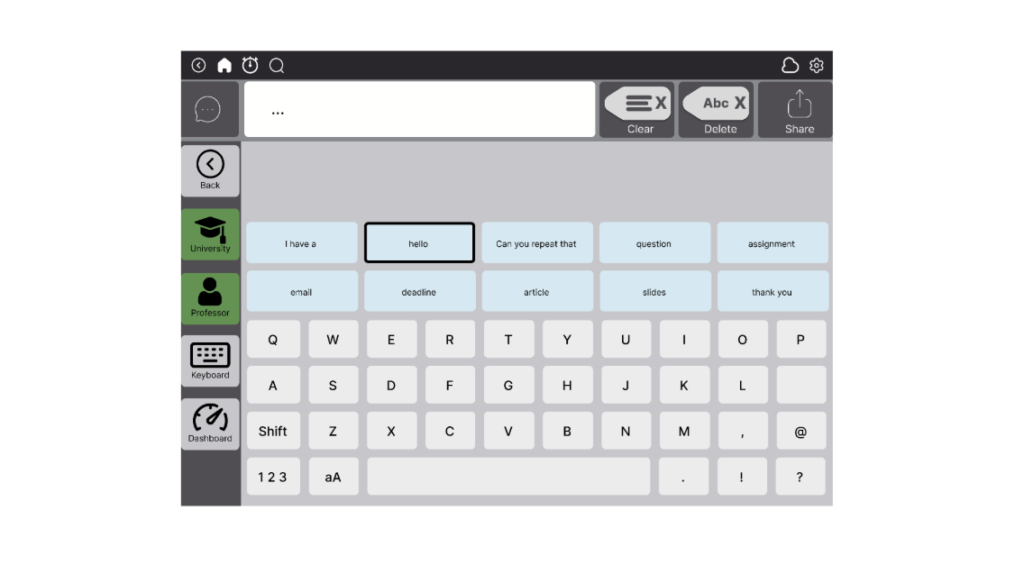
Wiktoria Sodel, Laura Moreno, Krish Waghresha, Kyle Nathan Yahya, Tamanna Shabnam
Conversations at Eye Level Through Intelligent Context.
For users of Augmentative and Alternative Communication (AAC), the pace of standard conversation can be a barrier, as formulating sentences often takes significant time. Team 3 has developed an intelligent keyboard that “knows you” by integrating contextual data such as location and the specific person you are talking to. By understanding whether the user is at a cafe or speaking with a professor, the system provides much more accurate word predictions. The goal is to reduce response time to just 1-2 seconds per phrase, transforming technical communication into natural interactions that truly feel like conversations.